
Tinder Dating App: Meet & Chat
Contains adsIn-app purchases
3.6star
6.98M reviews
100M+
Downloads

Mature 17+
info




About this app
Match, Chat, and Date. That’s our mantra.
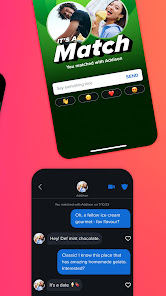
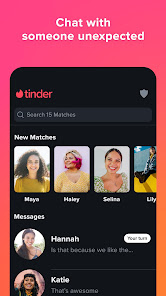
With 70+ billion matches to date, Tinder® is the top matchmaker dating app, and the best place to meet new people. Are you looking for true love? An open relationship? Are you looking to get out there and find a date, or do you just want to make friends and chat? With Tinder, you can meet local people everywhere and get the best out of your dating experience:
Whether you're straight, gay, bisexual, or anything in between, Tinder allows you to be who you are and find who you want.
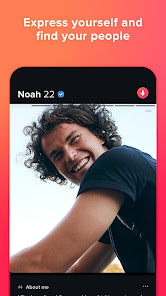
Share your interests and learn more about your matches to get the conversation started, and get the sparks flying.
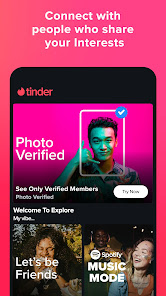
Photo Verified Profiles: Because the only surprises we want are flowers on the first date
Video chat: Test your online dating chemistry and meet new people from home!
Traveling somewhere? Get to know the singles from around the world. Dating in New York, meeting new friends in Miami, or going on a date in London: Wherever you go, we’ll be there.
Tinder Matchmaker - The Ultimate Friend Test
Discover the perfect way for potential matches to pass the friend test! With our newest feature, you can see who your friends Like for you. If ever in doubt or in need of a second opinion, use the Matchmaker feature to find the perfect match. Don't fret your match isn't all in their hands - whether your friend sends a Swipe Right™ or Swipe Left™, you still get to make the final call. What are you waiting for? Send your friend a matchmaker link and watch the story unfold!
It’s easy and fun to meet new people on Tinder®. Make your profile stand out with your best pics and a little something about you to increase your match-making potential. Use the Swipe Right™ feature to Like someone, use the Swipe Left™ feature to Nope. And no pressure: With our double opt-in feature, the interest has to be mutual in order to be a match. How many dating apps can say that?
While you’re here — make a toast to the Gold life and enjoy some of Tinder’s premium features with our Tinder Gold™ subscription
♥ Likes You — see all your fans, saving you precious time
♥ Unlimited Likes for you to catch feelings for as many new people as you want
♥ Rewind — undo your last Like or Nope
♥Passport — find people online outside your zip code
♥ Monthly Boost — put your profile to the top for thirty minutes to get more attention
♥ 5 Super Likes available per week
Looking for access to all of Tinder’s premium features? Join Tinder Platinum™ to also get your Likes prioritized with potential matches, to be able to message before matching, and more.
There’s a plus side for those not ready to commit to a relationship with Gold or Platinum. With Tinder Plus®, you’ll unlock features including Unlimited Likes, Unlimited Rewinds, and Passport.
So what are you waiting for? Download the best matchmaker dating app today! It doesn’t matter if you’re looking to make friends, meet new people or find your perfect match, Tinder is a place where everyone can find exactly what they’re looking for. — and it’s about time you showed up.
-----------------------------------
If you choose to purchase Tinder Plus®, Tinder Gold™, or Tinder Platinum™ payment will be charged to your Google Play account, and your account will be charged for renewal within 24-hours prior to the end of the current period. Auto-renewal may be turned off at any time by going to your settings in the Play Store after purchase. No cancellation of the current subscription is allowed during the active subscription period. If you don’t choose to purchase Tinder Plus®, Tinder Gold™, or Tinder Platinum™, you can simply continue using Tinder for free.
All photos are of models and used for illustrative purposes only.
Privacy: https://www.gotinder.com/privacy
Terms: https://www.gotinder.com/terms
With 70+ billion matches to date, Tinder® is the top matchmaker dating app, and the best place to meet new people. Are you looking for true love? An open relationship? Are you looking to get out there and find a date, or do you just want to make friends and chat? With Tinder, you can meet local people everywhere and get the best out of your dating experience:
Whether you're straight, gay, bisexual, or anything in between, Tinder allows you to be who you are and find who you want.
Share your interests and learn more about your matches to get the conversation started, and get the sparks flying.
Photo Verified Profiles: Because the only surprises we want are flowers on the first date
Video chat: Test your online dating chemistry and meet new people from home!
Traveling somewhere? Get to know the singles from around the world. Dating in New York, meeting new friends in Miami, or going on a date in London: Wherever you go, we’ll be there.
Tinder Matchmaker - The Ultimate Friend Test
Discover the perfect way for potential matches to pass the friend test! With our newest feature, you can see who your friends Like for you. If ever in doubt or in need of a second opinion, use the Matchmaker feature to find the perfect match. Don't fret your match isn't all in their hands - whether your friend sends a Swipe Right™ or Swipe Left™, you still get to make the final call. What are you waiting for? Send your friend a matchmaker link and watch the story unfold!
It’s easy and fun to meet new people on Tinder®. Make your profile stand out with your best pics and a little something about you to increase your match-making potential. Use the Swipe Right™ feature to Like someone, use the Swipe Left™ feature to Nope. And no pressure: With our double opt-in feature, the interest has to be mutual in order to be a match. How many dating apps can say that?
While you’re here — make a toast to the Gold life and enjoy some of Tinder’s premium features with our Tinder Gold™ subscription
♥ Likes You — see all your fans, saving you precious time
♥ Unlimited Likes for you to catch feelings for as many new people as you want
♥ Rewind — undo your last Like or Nope
♥Passport — find people online outside your zip code
♥ Monthly Boost — put your profile to the top for thirty minutes to get more attention
♥ 5 Super Likes available per week
Looking for access to all of Tinder’s premium features? Join Tinder Platinum™ to also get your Likes prioritized with potential matches, to be able to message before matching, and more.
There’s a plus side for those not ready to commit to a relationship with Gold or Platinum. With Tinder Plus®, you’ll unlock features including Unlimited Likes, Unlimited Rewinds, and Passport.
So what are you waiting for? Download the best matchmaker dating app today! It doesn’t matter if you’re looking to make friends, meet new people or find your perfect match, Tinder is a place where everyone can find exactly what they’re looking for. — and it’s about time you showed up.
-----------------------------------
If you choose to purchase Tinder Plus®, Tinder Gold™, or Tinder Platinum™ payment will be charged to your Google Play account, and your account will be charged for renewal within 24-hours prior to the end of the current period. Auto-renewal may be turned off at any time by going to your settings in the Play Store after purchase. No cancellation of the current subscription is allowed during the active subscription period. If you don’t choose to purchase Tinder Plus®, Tinder Gold™, or Tinder Platinum™, you can simply continue using Tinder for free.
All photos are of models and used for illustrative purposes only.
Privacy: https://www.gotinder.com/privacy
Terms: https://www.gotinder.com/terms
Updated on
Safety starts with understanding how developers collect and share your data. Data privacy and security practices may vary based on your use, region, and age. The developer provided this information and may update it over time.


Ratings and reviews
3.6
6.88M reviews

Bruce Hicks
- Flag inappropriate
- Show review history
April 13, 2024
It looks like the time of "the apps" are ending. Tinder used to be a reliable way of meeting a potential mate. Now it looks like those who are responsible for keeping the software to date have moved on. It rarely even loads all the way, let alone shows me potential matches in the seventh largest city in the US. Like most people, I'm usually on and off the apps. I think Tinder is completely done for me. There's no longer a benefit.
181 people found this review helpful

legalrod
- Flag inappropriate
- Show review history
April 10, 2024
I have a platinum level subscription,& despite numerous emails to support, I haven't been able to access any features I paid for--support has been zero help. Now, I'm trying to delete my account and it won't let me. I keep getting a message that "something went wrong, try again later". Just to DELETE AN ACCOUNT? Don't waste your money on Tinder.
216 people found this review helpful
Tinder
April 10, 2024
Sorry to hear you want to delete your account! We hope it’s because you met someone special. You can delete your Tinder account by tapping the profile icon > Settings > ‘Delete Account’. Having issues trying to delete your account? Let us know how we can help you at gotinder.com/help!

Ladre Weathersby
- Flag inappropriate
- Show review history
April 13, 2024
Costs too much. I did the year for $120. That was $10/month for Platinum. Now I couldn't renew the full year that day, so it canceled. NOW, GOLD is $6/week. For six months, that's almost $150!!! Yes for quality, but not at $600/year. I still can't filter out those who I have ZERO interest in (age, weight, distance are the biggest 3). Do better by dropping the price. Free is a joke. can't even see who liked you NOR can you respond. Don't even start spending money on super likes. THEY $5 each too!
56 people found this review helpful
What's new
bug fixes and improvements


